Diamond Certificates in Auctions

How to read a diamond grading report on an auction lot: every main field, what each color and clarity grade means, and how papers change what you should bid.

  • 17 min read
  • Updated July 2026
  • Category: Diamonds

Auction catalogs often list a diamond with a short grade string such as “1.02 ct G VS1 GIA.” That line compresses a full lab report. Below is each common field and grade, so you can match the lot to the paperwork and compare it to past sales.

Quick Answer

A diamond grading report describes one stone: weight, shape, color, clarity, cut-related grades, fluorescence, and often a plot of inclusions. It is not an appraisal of the jewelry’s retail value. GIA, IGI, HRD, and AGS use similar letter systems, but grades are not always interchangeable across labs. Verify the report number, match carat and measurements to the lot, and prefer comps with the same lab and grade band. Mounted “house grades” without a lab report are estimates, not the same as a certificate.

1.What a certificate is at auction

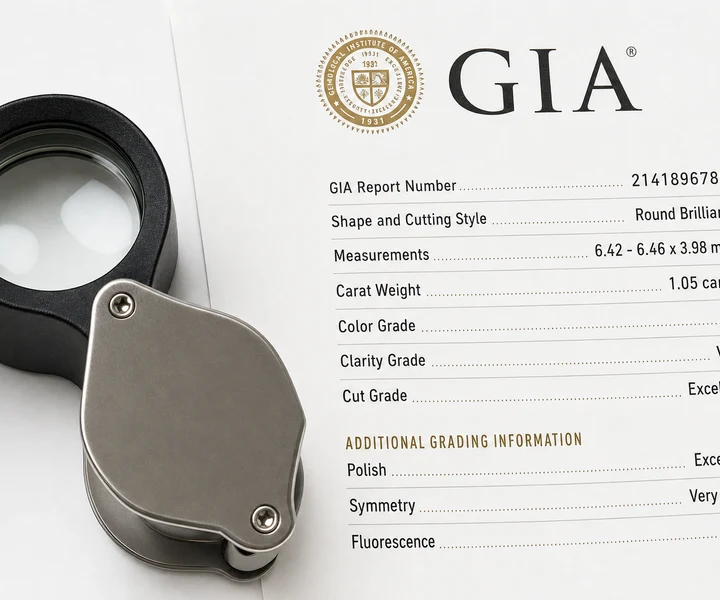
In auction catalogs, “certificate,” “report,” or “accompanied by GIA report” almost always means a diamond grading report from a gem lab. The lab measured and graded the loose stone (or graded it before mounting) and printed the results.

An appraisal is different. An appraisal assigns a dollar value for insurance or estate purposes. A grading report does not set what you should pay at auction; it describes quality so buyers can compare stones.

The report covers the diamond, not the mounting. A platinum Cartier setting and a plain gold shank can share the same center-stone grades and still sell for very different hammers.

Key point

Papers describe the stone. The lot price still depends on maker, period, condition, metal, and demand on sale day.

2.Why certificates matter when you bid

Past results are weak comps if one stone has a GIA VS1 F report and the other is “approximately G-H, VS” with no papers. Buyers pay for certainty as well as carat weight.

Lots without reports often sell softer because the winner takes grading risk. Lots with verifiable reports attract more remote bidders who will not handle the piece before the sale.

Most modern reports include a report number. Many stones also carry a laser inscription on the girdle that matches that number. Check both against the lab’s online lookup when the house provides a number.

  • Write down lab, report number, carat, color, clarity, and cut grades before you set a max bid
  • Add buyer’s premium to your all-in limit the same way you would for any other lot
  • Do not treat “report available on request” as verified until you have seen the PDF or lookup result

3.Report header fields

The top of a typical report identifies the stone before the quality grades.

Report numberUnique ID for this grading. Use it to look the report up on the lab’s site and to match a laser inscription.
Report dateWhen the lab issued the report. Older reports are still useful; recheck weight and condition if the stone was worn or remounted since.
Shape and cutting styleOutline and facet style, e.g. Round Brilliant, Emerald Cut, Oval Brilliant, Pear Modified Brilliant.
MeasurementsLength × width × depth in millimeters. Helps confirm the stone in the lot matches the paperwork.
Carat weightWeight to two or three decimal places (1.00 carat = 0.200 gram). Price jumps often sit at round weights such as 1.00 and 2.00 ct.
Laser inscriptionTiny text on the girdle, often the report number or “GIA” plus the number. Confirms the physical stone and the PDF are the same.

4.Color grade (D–Z)

For standard “white” diamonds, labs grade body color from D (colorless) to Z (light yellow or brown). The grade is set face-down under controlled light against master stones.

Fancy-color diamonds (strong yellow, pink, blue, and so on) use a different system (fancy light, fancy intense, etc.). Those grades are not on the D–Z scale.

Key point

One color grade step can change price more than a small carat difference once you are near a popular weight.

DCompletely colorless. Rare and priced at a premium. Face-up, D and E are hard for most buyers to tell apart.
EColorless. Tiny traces of color only a grader sees under lab conditions. Still top-tier for white diamonds.
FColorless on the standard scale. Last grade most buyers treat as fully “white” next to D and E.
GNear colorless. Very slight warmth that usually disappears in a white-metal setting for many eyes.
HNear colorless. Slight warmth may show beside a D–F stone; often looks white on its own in jewelry.
INear colorless. More noticeable warmth face-up, especially in larger stones or platinum settings.
JNear colorless / borderline faint. Warm tint is easier to see face-up; yellow gold can mask it.
KFaint yellow or brown. Color is visible face-up to most people; common in older and estate jewelry.
LFaint. Clear warm tone. Price drops versus near-colorless; still usable in yellow gold.
MFaint. Distinct tint. Often chosen when budget matters more than a bright white look.
N–RVery light yellow or brown. Warm color is obvious face-up. Graded letter by letter on the report (N, O, P, Q, or R).
S–ZLight yellow or brown. Strong body color on the white scale; beyond Z, stones may be graded as fancy color instead.

In yellow or rose gold, K–M stones often look intentional. In platinum or white gold, buyers usually pay up for G–H or better if they want a bright white face-up look.

5.Clarity grade

Clarity grades how clean the diamond is under 10× magnification. Internal features are inclusions; surface features are blemishes. The report’s plot maps the main ones.

“Eye-clean” is not a lab grade. It means you cannot see inclusions without a loupe. Many VS and some SI1 stones are eye-clean; SI2 and I grades often are not.

FL (Flawless)No inclusions or blemishes visible at 10×. Extremely rare; large price premium over IF.
IF (Internally Flawless)No inclusions at 10×; only minor surface blemishes. Still rare and expensive.
VVS1Very, very slightly included. Minute inclusions extremely difficult for a grader to see at 10×.
VVS2Very, very slightly included. Minute inclusions still very hard to find at 10×, slightly more than VVS1.
VS1Very slightly included. Minor inclusions difficult to see at 10×. Usually eye-clean in typical jewelry sizes.
VS2Very slightly included. Minor inclusions somewhat easier to find at 10× than VS1. Still often eye-clean.
SI1Slightly included. Noticeable at 10×. Many SI1 stones stay eye-clean; check the plot and photos.
SI2Slightly included. Easier to see at 10×; inclusions may show to the naked eye, especially in larger stones.
I1Included. Inclusions obvious at 10× and often visible face-up. Can affect transparency.
I2Included. More and/or larger inclusions. Durability or brilliance may suffer.
I3Included. Heavy inclusions. Clarity and toughness are clearly compromised; lowest standard clarity grade.

Read the plot and the Comments line. Two VS2 stones can look different if one has a tiny side inclusion and the other has a dark crystal under the table.

6.Cut grade

On many GIA-style reports, an overall Cut grade appears only for standard round brilliants. It combines proportions, polish, and symmetry into one face-up light-performance grade.

Fancy shapes (oval, emerald, cushion, pear, and others) usually list polish and symmetry, but not a single Excellent-to-Poor Cut grade.

Key point

A jump from SI1 to VS1 often moves price more than a jump from Very Good cut to Excellent, but a Fair or Poor cut can erase the benefit of strong color and clarity.

ExcellentTop proportions and finish for a round. Strong brightness and fire when well set. Often called “EX” in catalogs.
Very GoodSlightly looser proportions or finish than Excellent. Still bright; often a better value than chasing every Excellent.
GoodNoticeable trade-offs in light return or outline. Acceptable for many buyers; price usually lower.
FairWeak sparkle or awkward proportions face-up. Discount expected versus Good and above.
PoorCut clearly hurts appearance. Rare on fine jewelry auction lots; treat as a major defect.

7.Polish and symmetry

Polish grades the quality of the facet surfaces. Symmetry grades how evenly the facets are aligned. Both use the same five-step scale as Cut.

Excellent (polish)Facet surfaces are smooth under magnification. Minimal polish lines or abrasions.
Very Good (polish)Minor polish features at 10×. Rarely visible to the unaided eye.
Good (polish)Polish features easier to find under a loupe. May slightly soften brilliance.
Fair / Poor (polish)Rough or heavily marked surfaces. Expect a discount and inspect carefully.
Excellent (symmetry)Facet pattern is even; table and culet centered. Helps light return on rounds.
Very Good (symmetry)Small alignment variations at 10×. Still a strong finish grade.
Good (symmetry)Clear facet misalignment under magnification. Can look slightly “off” face-up on larger stones.
Fair / Poor (symmetry)Obvious misshapen outline or facet pattern. Usually a hard pass unless the price reflects it.

Catalogs often shorten this to “EX/EX” or “VG/VG” (polish/symmetry). That is finish quality, not the same as the overall Cut grade on a round.

8.Fluorescence

Fluorescence is how the diamond reacts under long-wave ultraviolet light. The grade describes strength, usually of blue fluorescence. Daylight can contain UV, so strong fluorescence sometimes changes face-up look.

Key point

Fluorescence alone should not decide a bid. Pair it with color, clarity, and how the stone looks in normal light.

NoneNo meaningful fluorescence. Neutral for most buyers; no UV-related discount.
FaintWeak reaction. Rarely affects appearance or price in a noticeable way.
MediumClear glow under UV. Usually fine in jewelry; some buyers ask for a small discount on higher-color stones.
StrongBright glow under UV. Can make a lower-color stone look whiter in daylight, or (less often) slightly hazy. Price impact varies by market.
Very StrongIntense glow. Highest chance of a “milky” or oily look in daylight on some stones. Inspect in person or via good video when possible.

9.Proportions, girdle, culet, and comments

Below the main grades, reports list proportion numbers and free-text comments. These help you understand cut quality on fancy shapes and explain unusual clarity calls.

Depth %Total depth divided by average diameter (or width). Very deep or very shallow stones can look smaller face-up for their carat weight.
Table %Width of the top facet relative to the diameter. Extreme tables can change fire and the size look of the stone.
Crown / pavilionAngles or heights of the top and bottom. Shown on many round reports; used with depth and table to judge cut.
GirdleThe rim of the stone (Thin, Medium, Thick, etc., sometimes with a mm range). Extremely thin girdles chip more easily; extremely thick girdles hide weight.
CuletThe bottom point or facet. None or Very Small is typical. A Large culet can show as a dark spot at the center.
CommentsLab notes such as “Clarity grade based on clouds” or “Pinpoints are not shown.” Read these; they explain what the plot does not fully capture.
Clarity plotMap of inclusions (usually red) and blemishes (usually green). Helps you judge whether a grade is “clean under the table” or busy on the side.

10.GIA, IGI, HRD, AGS, and others

Auction lots cite several labs. Letter grades look similar on paper, but labs do not grade identically. Comps work best when the lab matches.

GIA

Gemological Institute of America. Widely used reference for natural diamonds at major houses. Online report check is standard practice.

IGI

International Gemological Institute. Common on both natural and lab-grown diamonds. Check that the report states natural or laboratory-grown.

HRD / AGS / others

HRD (Antwerp) appears on European sales. AGS is known for cut-focused grading. Smaller labs exist; treat unfamiliar labs with more caution when comparing price.

A G color on one lab’s paper is not automatically the same as a G on another. When mixing labs in your comps, widen your bid range instead of averaging hammers as if grades were identical.

11.Natural vs lab-grown reports

Modern reports state whether the diamond is natural or laboratory-grown. That line matters more than the color letter for price.

Lab-grown diamonds can carry high color and clarity grades at much lower market prices than natural stones of the same grades. Mixing a lab-grown IGI VS1 F into a natural GIA comps set will mislead your bid.

If the catalog is silent on origin, open the report PDF or lookup. Do not assume “diamond” means natural.

Key point

Same grades, different origin: different market. Keep natural and lab-grown comps in separate piles.

12.Matching the lot to the report

Before you bid, confirm the paperwork belongs to the stone in the lot.

  • Carat weight and measurements should match the catalog within normal rounding
  • Shape on the report should match what you see in photos
  • Laser inscription, when listed, should match the report number
  • Be careful with “report available on request,” missing PDF links, or grades that only appear in marketing text
  • If multiple diamonds are in the lot, check whether the report covers the center stone only

13.Mounted stones and approximate grades

Auction houses often estimate color and clarity for diamonds left in the mounting. Those grades appear as “approximately,” “approx.,” or “in our opinion.”

Mounted grading is harder: metal covers the girdle, and the setter’s work can hide or emphasize inclusions. House grades are a starting point, not a lab report.

A full lab report usually means the stone was graded loose (or was accompanied by an older loose report). That is stronger evidence for comps and for resale later.

Key point

“Approx. G-H, VS” from the house is not the same as “G VS1” on a GIA report.

14.From grades to a bid number

Two similar rings can sit in the same estimate band and still deserve different max bids once papers are in the picture.

Lot A1.01 ct round, GIA F VS1, EX cut, no fluorescence, papers verified
Lot B1.00 ct round, house grade “approx. G-H, VS,” no lab report
Recent comps (sold)Similar GIA F–G VS1 rounds hammered $4,800 / $5,100 / $5,400
Working range Lot AHammer about $4,900–$5,300 before premium
Working range Lot BDiscount for grading risk: often 15–30% below certified comps, then confirm with unsold comps

Build the hammer cap from your all-in budget after premium, then ask whether the papers support sitting near the top of the comps or force you lower. How to Compare Jewelry Auction Results covers the full comps workflow.

15.Common mistakes

  • Treating an appraisal dollar value as a grading report
  • Comparing GIA and IGI grades as if they were identical
  • Mixing lab-grown and natural comps
  • Ignoring the Comments line and clarity plot
  • Assuming SI2 is always eye-clean because SI1 often is
  • Bidding as if house “approximate” grades were lab grades
  • Forgetting that the report does not grade the mounting or brand
  • Skipping online report verification when a number is published
Frequently Asked Questions

Do I need a GIA report, or is another lab fine?

GIA is the most widely accepted reference for natural diamonds at many major sales, but IGI, HRD, and others appear often. What matters is verifying the report and comparing like with like. Unfamiliar labs deserve a wider bid discount.

Can I verify a diamond certificate online?

Yes, for most major labs. Enter the report number on the lab’s report-check page and confirm carat, shape, color, and clarity match the catalog.

What does the clarity plot show?

It maps the main inclusions and blemishes used for the clarity grade. It helps you see whether issues sit under the table (more visible face-up) or toward the edge (easier to hide in a setting).

Does fluorescence matter?

Sometimes. None and Faint rarely change the deal. Strong and Very Strong can help or hurt face-up look and may affect price. Judge the stone in normal light, not by the fluorescence line alone.

What if the report is several years old?

Grades do not expire, but the stone can chip or the jewelry can be altered. Recheck measurements, inscription, and condition photos against the old PDF.

Are lab-grown certificates different?

They use similar grade fields, but the report must state laboratory-grown. Prices follow the lab-grown market, not the natural market, even when color and clarity look “better on paper.”

Does the certificate cover the whole piece of jewelry?

Usually no. It grades one diamond (often the center stone). Side stones may be estimated separately or left ungraded.

What do the Comments on a report mean?

They explain grading details the plot may not show fully, such as clouds, needles, or manufacturing remnants. Read them before you treat two stones with the same clarity letter as equals.

Unlock full auction research

Get premium access to past auction results, price comparisons, saved lots, brand alerts, and advanced search filters.